
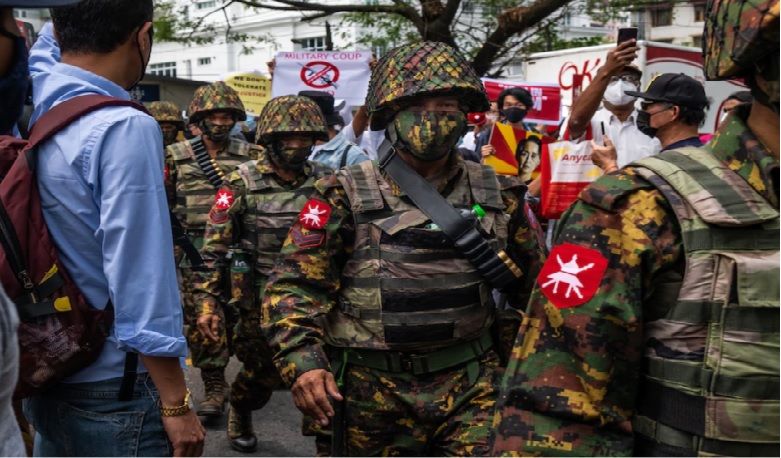
The occurring impact on Myanmar's democracy through military rule of Myanmar
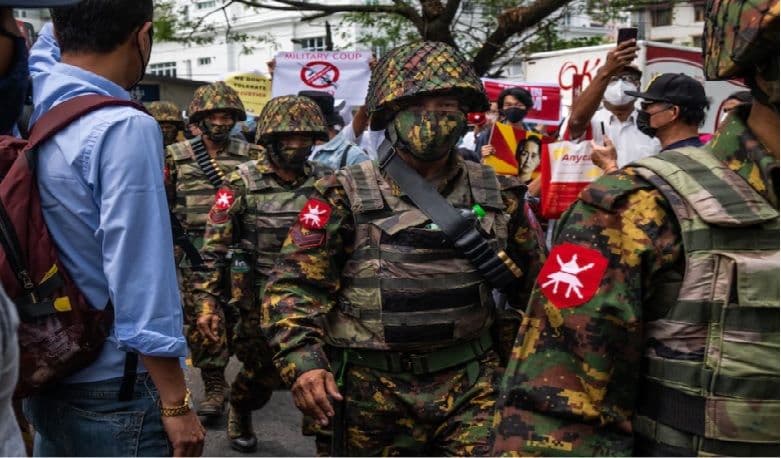
Figure 2.0 – Myanmar military copes
Eduardo Galeano, a famous Uruguayan journalist and author, said that most wars, military coups, or invasions are done in the name of democracy and against democracy. The author's statement above is in practice in Myanmar today. If mentioned further, we can see the visible aspects of the above statement through the damage done to the democratic principles of Myanmar through the military rule in Myanmar. Currently, Myanmar’s military rule has violated the country's democratic principles and affected the political security of the Myanmar people. Studying this topic is a contemporary need. Because the military rule in Myanmar has recently become an international crisis. Today, the military junta, led by the General Min oun, is governing the government in Myanmar. Also, this military junta plays all the prominent roles of the state in Myanmar.
History of military rule of Myanmar
Natural resources such as natural gas, oil, timber, gold, tin and gems are plentiful in Myanmar. However, Myanmar is considered to be an underdeveloped country by the United Nations with such a large amount of natural resources. This list also includes countries such as Rwanda, Somalia, Afghanistan, Sudan, Zimbabwe and Uganda. Critics point to extreme poverty caused by military rule, prolonged civil war, and slow economic growth as the reasons why Myanmar, which was a rich country in Asia in the early 1950s, has reached this point.
On January 4, 1948, Burma (now Myanmar) gained independence from the British and became an independent state. But anti-government uprisings began in Burma by other parties and armed groups against the post-independence ruling government. Due to this, internal instability was formed in Burma. Then, in 1962, under General Ne Vin, the army coopted the state of Burma. The military later banned all opposition parties, and all businesses and industries were controlled by the military. Since then, for nearly five decades (nearly 50 years) from 1962 to 2011, Myanmar (Burma) ruled under military rule. During this period, civil society organizations and the people of Myanmar stood up against military rule. During this period, civil society organizations and the people of Myanmar stood up against military rule. But in those days, the Myanmar military suppressed the uprisings in a manner that was anti-democratic and violated human rights. For example, in 1988, a series of anti-government demonstrations took place in Myanmar, during which General Ne Vin left power. However, General Saw Maung, who soon seized power in Myanmar, ruthlessly suppressed the uprising by killing a large number of people.
The political power of the Myanmar military
A double system of law governs the Parliament of Myanmar, as upper and lower chambers. 330 of the 440 members of the Lower House are elected by simple majority vote, while the remaining 110 members are appointed by the country's military. In the upper chamber, 168 of the 224 seats will be chosen by an easy majority and 56 from the military have been appointed. As a result, the military has gained significant control over Parliament despite the transition to democracy. Thus, even in a democratic society, the army now has considerable power at Parliament. In addition to the 25% parliamentary power, the army has been given powers in the areas of tourism, gems, tobacco and transport. In addition, all aspects of security in Myanmar are under the military's control. And under the new constitution, the Myanmar military maintains its monopoly over the country's mining, oil and gas industries. And under the new constitution, the Myanmar military maintains its monopoly over the country's mining, oil and gas industries.
A report released in 2020 by Amnesty International revealed that between 1990-2010, $18 billion was earned through military-controlled businesses. And most of this money was invested in the budget of the army. These phenomena show that the Myanmar military has gained dominance in various economic fields through the new constitution and through this dominance, the Myanmar military has gained political power. It has directly and indirectly affected Myanmar's democracy, especially due to the increased political power of the Myanmar military.
The impact of military rule on democratic principles in Myanmar today
The military coup against the government of that country by the Myanmar army in 2021. During this military coup, the military arrested senior members of Myanmar's then-ruling party, the National League for Democracy (NLD). Many of those arrested have been placed under house arrest by the army. Military regimes that take over state control from time to time are not a new experience for the people of Myanmar. But the problem is the impact on democratic principles due to the problems and issues created by these military regimes. The Myanmar people started peaceful protests against the military coup on February 1, 2021, but the Myanmar army violently repressed the protest. As a result, nearly 800 people died, and nearly 6,000 people were arrested by the army.
The principles of conducting free and fair elections, conducting peaceful protests, and protecting the human rights of the people are embedded in democracy. These principles have been violated by military regimes in what is seen as Myanmar's military rule. In 2021, the use of live ammunition to suppress the people's protests against the Myanmar military coup and shoot at protesters and people's homes is a violation of international democratic principles. Internationally, the United States, China and European countries accuse the Myanmar army of the violence committed by the army against the Rohingya people and the human rights violations of the minorities in Myanmar. The World Bank emphasizes that the current military rule in Myanmar threatens the country's development. The reason for this is that the current military rule in Myanmar is causing a severe setback to the country's development prospects. Overall, the decades of military rule in Myanmar have created a fragile phenomenon of democracy in Myanmar. That is why Myanmar is currently in a severe economic crisis.
References
Asanka,D.(2021, March 29). The Blurred Dream of Democracy– Myanmar. Roar Media Archive. https://archive.roar.media/sinhala/main/reports/myanmar-coup-2021-whats-happening
Clare,A. (2021, August 4). The Myanmar coup: a quick guide .https://www.aph.gov.au/About Parliament/Parliamentary_departments/Parliamentary_Library/pubs/rp/rp2122/Quick_Guide MyanmarCoup
Jazeera, A. (2021, February 2). Myanmar military coup threatens country’s development: World Bank.AlJazeera. https://www.aljazeera.com/economy/2021/2/2/myanmar-military-coup threatens-country?traffic_source=KeepReading&_gl=1*1miw8u8*
Jazeera, A. (2021, February 2). Myanmar military coup threatens country’s development: World Bank.AlJazeera. https://www.aljazeera.com/economy/2021/2/2/myanmar-military-coup threatens-country?traffic_source=KeepReading&_gl=1*1miw8u8*
Limaye, Y. (2024, June 6). Inside Myanmar: The devastating cost of fighting the military junta. https://www.bbc.com/news/articles/cydd87gen62o
Maizland, L. (2022, January 31). Myanmar’s troubled history: coups, military rule, and ethnic conflict. Council on Foreign Relations. https://www.cfr.org/backgrounder/myanmar-history-coup-military-rule-ethnic-conflict-rohingya
Marston, H. (2021, October 5). Analysis: Why is Myanmar’s military so powerful? Al Jazeera. https://www.aljazeera.com/features/2021/2/2/analysis-why-is-myanmar-military-so-powerful
Merline. (2023, October 30). THE EMERGENCE OF MILITARISM: ANALYZING MYANMAR AND SUDAN. ProjectStatecraft. https://www.projectstatecraft.org/post/the-emergence-of-militarism-analyzing-myanmar-and-sudan
Sumanapala,C.(2017, January 12). Myanmar after independence. Roar Media Archive.https://archive.roar.media/sinhala/main/features/post-independence-myanmar
Figure References
Figure 1.0
Siow, M., & Siow, M. (2021, February 22). Myanmar coup: as the military’s patience wears thin, a call to prevent further bloodshed. South China Morning Post https://www.scmp.com/week-asia/politics/article/3122685/myanmar-coup-militarys-patience-wears-thin-call-prevent-further
Figure 2.0
Parashar,R.(2022,November19).New Delhi’s Tatmadaw conundrum. Samvada World. https://samvadaworld.com/national/new-delhis-tatmadaw-conundrum/