Marital rape, nonconsensual sex within marriage is still a legally and culturally contentious issue in Sri Lanka. Despite the growing body of international human rights norms that affirm women’s right to bodily integrity, Sri Lanka’s laws and social norms continue to deny married women’s protection from rape by their husbands. This question brings upon the tenacity of patriarchy and the difficulty of modernizing legal and societal approaches that some believe are part of the marital customs’ nature. In this article, we analyse the legal and cultural barriers to addressing this issue in Sri Lanka and chart possible paths to reform.
The Legal Exemption for Marital Rape in Sri Lanka
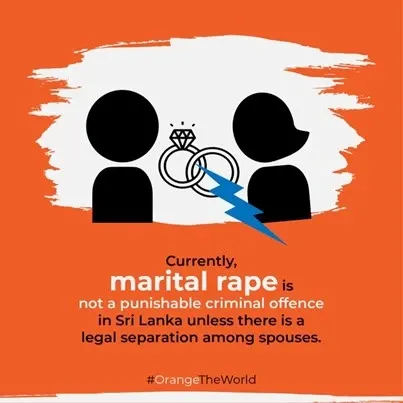
According to Sri Lanka’s Penal Code, rape is defined as sexual intercourse with a woman without her consent but with an exemption for married couples. Non-consensual sexual intercourse between a husband and a wife is not an offence if the wife is more than 12 years of age. Unless there is a court order legally separating the husband and wife.
The stance of Sri Lanka’s marital rape has been criticized by the United Nations and other international bodies as a gross human rights abuse. But local lawmakers have been somewhat reluctant to change the law, typically on grounds of ‘marital harmony’ and ‘family values. This legal lacuna reflects the traditional ideal of marriage as one in which wives must satisfy their husbands’ sexual desires. This continues to prevail over the ideas of individual consent and bodily autonomy.
Cultural and Religious Barriers to Legal Reform
The Sri Lankan legal exemption for marital rape highlights cultural and religious values that see the husband as having ultimate authority over marriage. According to the dominant Sri Lankan marriage culture, it is a lifetime commitment with rigid gender roles, and the husband is expected to be in charge, including terms of sexuality as well. This dynamic makes women subservient, and their denial of sex as an assault on the marriage and the authority of the husband.
“As a wife, I had no authority to refuse. I was told, it was my obligation, no matter how I felt about it, or even if I did or did not consent, to fulfill my husband needs. I kept my mouth shut for years because I was petrified of being criticized and by the consequences of speaking out.” -Words of one of the survivors-
Religious attitudes also contribute to the unwillingness to acknowledge this. Sri Lanka’s dominant faiths: Buddhism, Hinduism and Islam, all have multiple perspectives on gender and marriage, yet conservative interpretations are commonly invoked as the basis of a husband’s claim to sex. While interpretations can differ, many religious and traditional leaders oppose criminalising marital rape, believing that it would desecrate marriage or go against religious doctrine.
The Impact on Women’s Health and Well-being
The absence of legal recourse for sexual violence for married women has several health and well-being related consequences. Survivors also experience increased physical injuries, sexually transmitted infections and accidental pregnancies. Forced sex in marriage can cause depression, anxiety, post-traumatic stress disorder, and the social stigma of being forced to speak about sexual assault. Not only this silence let the abuse to continue, but it also gets naturalized, and women might think that rape is an inevitable part of marriage.
Pressure for Reform and the Need for Legislative Change
Sri Lanka is formally bound to uphold women’s rights, including their right to bodily autonomy, in accordance with international conventions such as the Convention on the Elimination of All Forms of Discrimination Against Women (CEDAW). Still, significant legal reform to address marital rape has been sluggish. Repetitive arguments and pressure to abolish this exemption have run up against conservative opposition in government and civil society, with legislators frequently citing the need to defend the status quo against a backlash. Reform opponents also contend that criminalising marital rape would undermine family cohesion or be ‘foreign’ values, and therefore reinforce the notion that consent is de facto eternal.
Organizations like the Women's Action Network (WAN) and the Centre for Women’s Research (CWR) have also been advocating for women’s rights and challenging harmful gender norms in Sri Lanka.
Addressing Cultural Norms and Shifting Perceptions
While legal reform is vital to the issue, so too is a shift in societal attitudes and understandings of marriage and consent. Consent and bodily autonomy can be normalized and traditional understandings of those challenged through public awareness campaigns. Programs that engage communities in discussions about respectful relationships and highlight the importance of consent within marriage can help shift attitudes that uphold the marital rape exemption. Schools, community centres and public information campaigns are also key to educating the public and destigmatising discussions about sexual autonomy and respect.
To challenge and transform the attitudes that fuel this, it is necessary to involve men. Programs that engage men in dialogue about consent and non-violence in marriage can also challenge toxic notions of gender and marriage. Positive depictions of equal partnerships in the media and in public campaigns can also contribute to the reframing of what a healthy marriage should be in contemporary Sri Lanka, prompting men and women to see and value each other's independence.
Conclusion
The question of marital rape in Sri Lanka highlights the entrenched legal and cultural obstacles to women’s rights and bodily integrity. The legal failure to protect married women from sexual violence in marriage is an example of unwillingness to take on patriarchal and religious ideologies, according to which wives are required to give unconditional sexual consent. Criminalising marital rape by amending the law is important, but it should be part of a wider struggle to change cultural norms around marriage, gender roles and individual rights. This combination of activism, education and the mobilisation of men and women can help to create a future where all Sri Lankans are safe from sexual violence, whether they are married or not.
If Sri Lanka can accept these changes, it will also be one step closer to a society that values and safeguards women’s rights, and in the process, healthier, more respectful and equitable relationships in marriage.
References
Wijesinghe, D. (2024, May 19). Marital rape: A legal blind spot. Latest in the News Sphere | the Morning. https://www.themorning.lk/articles/INeHtnG7suGAUgX8mXim.
Rodrigo, A. (2024, March 25). Sri Lanka to criminalize marital rape: Justice Minister. EconomyNext. https://economynext.com/sri-lanka-to-criminalize-marital-rape-justice-minister-155960/.
Equality Now. (n.d.). Sexual Violence in Sri Lanka. Equality Now. https://equalitynow.org/learn_more_sexual_violence_in_sri_lanka/.
Centre for Policy Alternatives. (2020). Legal Reform to Combat Sexual and Gender-based Violence; Reforming Existing Laws and Policies-Part I. Centre for Policy Alternatives. https://www.cpalanka.org/wp-content/uploads/2020/11/Law-Reform-to-combat-SGBV-PART-1-General-Centre-for-Policy-Alternatives.pdf.
Pulse.lk. (2024, June 26). Does Marriage Excuse Rape? YouTube. https://www.youtube.com/watch?v=p9p1vzx5ArU
Ekanayake, P. (2019). The Necessity of Criminalizing Marital Rape in Sri Lanka. Asia Pacific Institute of Information Technology.