INTRODUCTION
“I am dying bit by bit. Sometimes when I set off on the road, I wish that a vehicle would hit me. But she [pointing to the other lady next to her] says don’t die, we will see them again…we will”
- Mother at Kandavalai Public Meeting
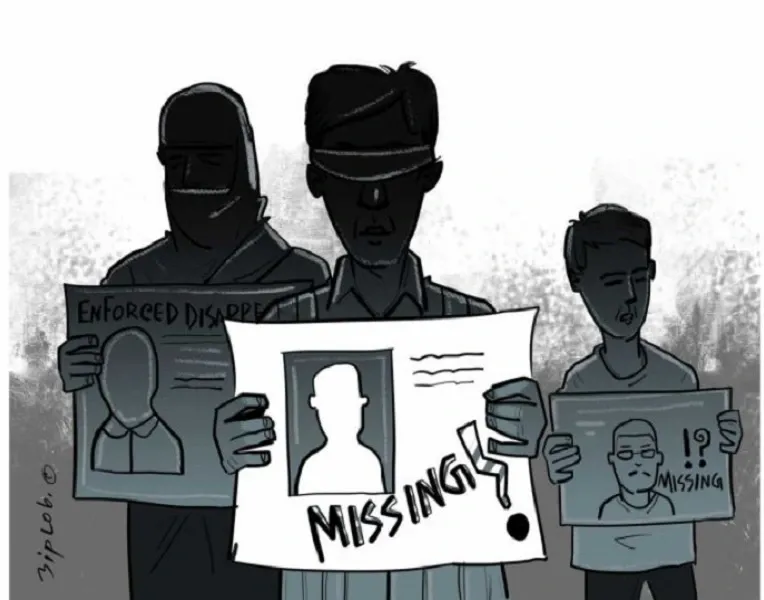
An enforced disappearance is considered to be the arrest, detention, abduction or any other form of deprivation of liberty by agents of the State or by persons or groups of persons acting with the authorization, support or acquiescence of the State, followed by a refusal to acknowledge the deprivation of liberty or by concealment of the fate or whereabouts of the disappeared person, which places such a person outside the protection of the law. Overall figures for enforced disappearances in Sri Lanka are over 100000 in the late 80s up to the mid-90s, while about 65,000 complaints have been documented since 1995 as the former president and the head of the government’s Office on National Unity and Reconciliation Chandrika Bandaranaike Kumaratunga acknowledged in 2016.
Government death squads made disappearances of Sinhalese youth whom they suspected of having JVP affiliations and disappeared in greater numbers during the years 1989 and 1990. Similar actions were undertaken by the police, military and paramilitary operatives against Tamils suspected of having connections to the LTTE between 1983 and 2009 during the armed conflict.
The LTTE captured and abducted males and females of all ages to use as soldiers and so many are missing to this day. Human rights defenders, employees of humanitarian aid agencies, and community leaders were also subjected to enforced vanishment. Prevention of Terrorism Act (PTA) makes provisions for administrative orders of detention which can be further classified as incommunicado detention that has contributed to the enforced disappearance.
OBLIGATIONS OF SRI LANKA UNDER INTERNATIONAL LAWS
Sri Lanka is bound by its obligations under international law, including the International Covenant on Civil and Political Rights (ICCPR) and the International Convention for the Protection of All Persons from Enforced Disappearance (ICPPED) to undertake impartial and independent investigations in cases where the state forces or non-state actors abduct person(s) or make other forms of disappearances and to punish perpetrators and to provide and enforce effective remedies for victims.
As a reflection, Sri Lanka has taken three major steps in giving effect to its obligations. They are,
- Passing legislation, namely, the International Convention for the Protection of All Persons from Enforced Disappearance Act in March 2018, to give effect to ICPPED within its jurisdiction and to criminalize enforced disappearance.
- Establishing an Office on Missing Persons (hereinafter ‘OMP’) to remedy the victims of enforced disappearances.
- Appointed presidential commissions from time to time to investigate and prepare a report on Reconciliation Mechanism.
OFFICE ON MISSING PERSONS (OMP)
In July 2016, the OMP was created through legislation. In February 2018 the OMP commissioner (Saliya Pieris) was appointed, which allowed the office to function. As a permanent and functional entity, OMP provides comprehensive strategies to deal with and resolve the issues of missing and disappeared persons in Sri Lanka. It is responsible for receiving complaints, conducting investigations and clarifying the fate and whereabouts of missing and disappeared persons.
The OMP published the details of complaints known as ‘the provincial list’ which it has received from the families and relatives of missing persons and requested the public to assist them in finding the missing persons. As per record till 14h of February 2023, the overall number of current cases of missing people is 14988, while 2647 preliminary inquiries have been completed.
The OMP and ICPPED Acts look good on paper, but in practice they are unsatisfactory. The stand taken by each government that is coming to power one after another plays a crucial role in the effective functioning of these mechanisms. Some allege that the Sri Lankan authorities have cleverly developed and practiced over a long period in blindfolding the UN, OHCHR and other UN agencies relating to Human Rights by bringing up best practices theoretically.
This can be seen as a longstanding structural issue that has impeded or undermined prosecutions. A good example of this is the role played by the Attorney General’s Department, which acts as both, the prosecutor in cases of alleged enforced disappearances and defends respondents in the legal proceedings including habeas corpus writs. OMP has been subjected to state obduracy, including a lack of due recognition. To be able to successfully fulfil its mandate, the OMP must engage with a range of Government ministries and commissions, which cause a practical bar where such ministries are politicized and not willing to cooperate. There is also a lack of will to investigate and prosecute the cases by the Government, even where credible evidence of crime exists.
PRESIDENTIAL COMMISSIONS
The initial commission tasked with investigating cases related to missing and enforced disappeared individuals was established by former President Chandrika Kumaratunga in 1995. Subsequently, various commissions were appointed by successive governments. One notable commission is the Consultation Task Force (CTF) on Reconciliation Mechanism, which was created in 2016. The CTF's objective was to engage in public consultations regarding the design of mechanisms for truth, justice, reparation, and non-recurrence. It received over 7,000 submissions from across Sri Lanka, many of which came from family members of the disappeared. In January 2017, the CTF released a comprehensive final report to the President, containing valuable findings. However, a significant majority of the specific recommendations put forth by the CTF and other commissions are not yet implemented.
A new Presidential Commission of Inquiry was established to examine the findings of previous commissions and committees, which in February 2023, presented the draft final report to the then President outlining a summary of recommendations. The executive summary highlighted approximately 27 recommendations. Placing particular emphasis on enhancing the institutional capabilities of the Office on Missing Persons, Office for Reparations, and Office for National Unity and Reconciliation. The summary also mentioned the proposal to establish a Truth and Reconciliation Commission. Furthermore, it emphasized the importance of achieving guarantees for non-recurrence through institutional reforms and a clear policy statement endorsing zero tolerance for actions that violate international human rights law and international law.
CONCLUSION
Jakob Kellenberger claims that ‘forced disappearances negate the very existence of the human being and deny the person in question the basic legal protection to which every man or woman is entitled, no matter whether they are guilty or innocent. Sri Lanka bears the responsibility, both domestically and internationally, to eliminate and punish this atrocious act.’ Accountability, for the crimes of enforced disappearance has had an impact on every community, in Sri Lanka. But the efforts made by the country so far have not met the expected standards.
Moreover, the Office of Missing Persons (OMP) is a component of a larger transitional justice program; other comparable systems have not been completely implemented yet causing doubts, about their efficacy. Although finding missing individuals and offering information to affected families should be a priority holding accountable those, for enforced disappearances is crucial. If it can be established in court with evidence that there have been widespread and organized enforced disappearances it could potentially constitute crimes against humanity.
To move away, from its past and progress positively in the future Sri Lankan leaders need to focus on meeting the needs of those affected which include fair treatment, for victims and steps to prevent similar incidents from happening again.
Reference
- Consultation Task Force on Reconciliation Mechanisms (CTF), Interim Report: The Office on Missing Persons Bill and Issues Concerning the Missing, the Disappeared and the Surrendered [2016] p. 13, <https://docs.wixstatic.com/ugd/bd81c0_1872d48845bd45afaafa7813ce2c89a0.pdf> accessed on 24 October 2024.
- United Nations (General Assembly), International Convention for the Protection of all Persons from Enforced Disappearance [2010] (ICPPED)
- Declaration on the Protection of all Persons from Enforced Disappearance, 1992
- Amnesty International, ‘Only justice can heal our wounds: Listening to the demands of families of the disappeared in Sri Lanka’ (2017) p. 7 <https://www.amnesty.org/en/documents/asa37/5853/2017/en/> Accessed on 24 October 2024.
- Prevention of Terrorism (Temporary Provisions) Act No. 48 of 1979
- United Nations (General Assembly), International Covenant on Civil and Political Rights [1966]
- Office on Missing Persons (Establishment, Administration and Discharge of Functions) Act No.14 of 2016 (OMP Act)
- News First, ‘President’s Counsel appointed Chairman of Office of Missing Persons’ [2018], <https://www.newsfirst.lk/2018/03/01/191291/> Accessed on 24 October 2024.
- The List of Complaints and Information Regarding Missing and Disappeared Persons Received by the Office on Missing Persons <http://www.omp.gov.lk/missing-persons> Accessed on 24 October 2024.
- Basil Fernando, ‘Office on Missing Persons and the Zero Policy on Justice’ [2021], Ground Review, <https://groundviews.org/2021/06/04/office-on-missing-persons-and-the-zero-policy-on-justice/> Accessed on 24 October 2024.
- Chulani Kodikara, ‘The Office on Missing Persons in Sri Lanka: Why Truth Is a Radical Proposition’ [2023], <https://academic.oup.com/ijtj/advance-article/doi/10.1093/ijtj/ijad005/7078879> Accessed on 24 October 2024.
- President of the International Committee of the Red Cross (ICRC) at the opening for signature of the International Convention for the Protection of all Persons from Enforced Disappearance (February 2007)