When I started kindergarten, I spoke only Spanish. My family had one source of income, and like many low-income families in California, our neighborhood school was not going to give me the foundation I needed. So my parents enrolled me in the District of Choice program: a California initiative that allows students to attend school outside their home district, opening the door to more resourced, academically rigorous environments that would otherwise be inaccessible to us.
That decision changed the trajectory of my life. It also showed me, from the very beginning, how much the circumstances of your birth determine the quality of your education in America.
The System Built on Zip Codes
The United States largely funds its public schools through local property taxes. Schools in wealthy neighborhoods, where property values are high, receive significantly more funding per student than schools in lower-income areas. Two schools in the same city, only a few kilometers apart, can offer vastly different educations. One has updated textbooks, well-paid teachers, advanced coursework, and a full arts program. At the other, teachers pay for supplies out of their own pockets.
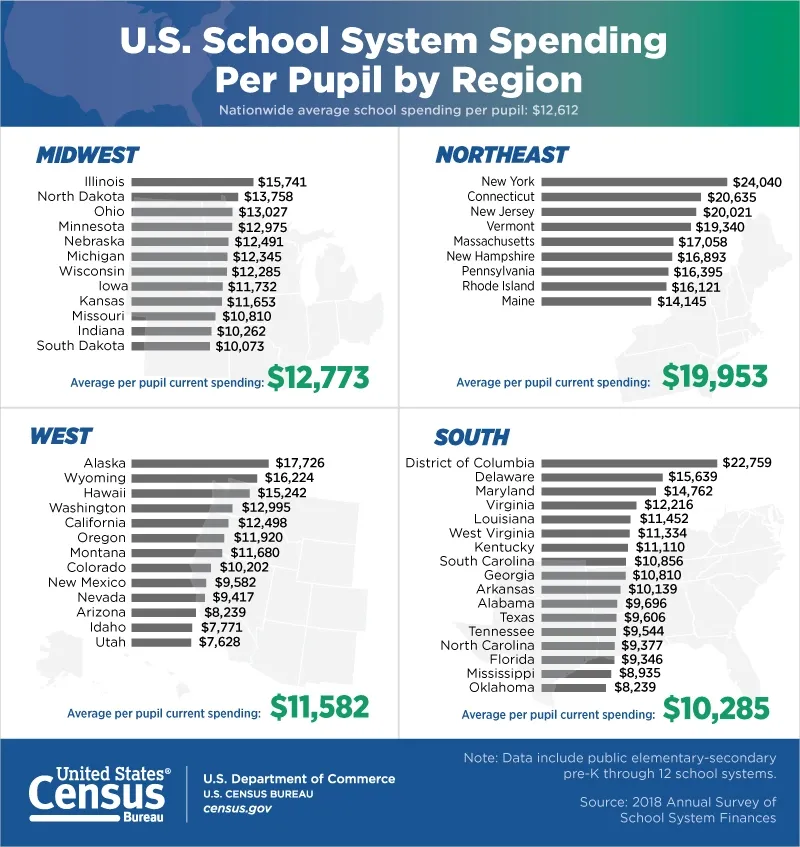
The data reflects this clearly. According to the U.S. Census Bureau's Annual Survey of School System Finances, per-pupil spending averages $19,953 in the Northeast and just $10,285 in the South. Within regions, the disparities between wealthy and low-income districts are even sharper.
A child's potential does not change based on their zip code; their resources do.
Where Wealth Can Get You
The gap does not stop at school funding. Affluent families can afford private tutoring, SAT and ACT prep courses, and college counselors who craft applications that stand out. Services that can cost thousands of dollars and are simply inaccessible to families living paycheck to paycheck. Students of equal intelligence and motivation do not arrive at the college admissions process on equal footing.
Extracurricular activities expand this divide further. Sports leagues, music lessons, academic competitions, and summer enrichment programs all carry costs that low-income families struggle to cover. Yet these are precisely the experiences that build the profiles universities and employers look for. Participation becomes a privilege rather than a right.
Trailblazing
I experienced this firsthand. When I entered high school, I enrolled in the Project Lead the Way Computer Science Pathway: a rigorous, career-focused program. I did not know it at the time, but I would be one of three students of color to do so in the entire grade, and one of fewer than ten girls. I earned a 4 and a 5 on my Advanced Placement Computer Science exams. I excelled. But I should not have been the exception. That experience made something very clear to me: the pipeline for underrepresented students in technology does not break because of ability. It breaks because of access to programs, to resources, and to the environments where those interests are nurtured in the first place.
My Journey to Advocacy
The inequities I witnessed did not make me retreat. They made me act.
At the age of seven, I began working alongside my school district's superintendent to support outreach efforts that would help ensure the longevity of the District of Choice program so that other families like mine could continue to access it. That early advocacy grew over time into something larger.
I became Senator Newman's District of Choice Student Testifying Witness, representing all California District of Choice students. I delivered speeches before the California Senate and Assembly Boards of Education, and to school districts across the state. The message was straightforward: students should not be limited in their educational options because of their socioeconomic status. That advocacy contributed to the passage of California Senate Bill 897, legislation designed to remove barriers to education for low-income students.
Standing in those chambers, I understood something that no classroom had taught me directly:
Policy is not made by distant people in powerful rooms. It is shaped by the voices willing to enter those rooms and speak.
What Other Countries Have Figured Out
Educational inequality is not a uniquely American problem, but the United States stands out for how deeply its funding model entrenches it. In Finland, school funding is distributed equitably at the national level, and there are no elite private schools creating parallel systems for the wealthy. In Canada, provincial governments ensure more balanced resource distribution across communities. South Korea has dramatically narrowed achievement gaps through targeted investment in underfunded districts over two decades.
These are not perfect systems. But they prove that the divide between a wealthy child's education and a low-income child's education is not inevitable. It is the result of policy choices, which means it can be changed by policy choices.
Young People Take Action
Sustainable Development Goal 4 calls for inclusive, equitable, quality education for all by 2030. We are not on track to meet it. But across the world, young people are not waiting for systems to change on their own. They are testifying before legislatures, building peer tutoring networks, advocating for funding reform, and running for school boards. They have been affected by these systems, but they are contributing to actively reshaping them.
If you believe education should be a right and not an outcome of wealth, there are ways to act. Learn how your school system is funded. Engage with organizations working on educational equity. Find out if programs like District of Choice exist in your region and support efforts to expand them. And if you have a story, tell it. I have learned firsthand that personal testimony changes minds in ways that statistics alone cannot.
The question is not whether it is possible to build an education system where your family's bank account does not determine your potential. It has already been done elsewhere. The question is whether the will exists to do it here, and whether young people will keep pushing until it does.
Education should be a right. In America, for too many, it remains a privilege. That is something worth fighting to change.
References
Ivan Aleksic / Unsplash — Classroom photograph (free use license): https://unsplash.com

U.S. Census Bureau — 2018 Annual Survey of School System Finances: https://www.census.gov/content/dam/Census/library/visualizations/2020/comm/school-system-finance.jpg
National Center for Education Statistics — School Finance Data: https://nces.ed.gov
OECD — Education at a Glance: https://www.oecd.org/education/education-at-a-glance
UN Sustainable Development Goal 4 — Quality Education: https://sdgs.un.org/goals/goal4
California Legislative Information — SB 897: https://calmatters.digitaldemocracy.org/bills/ca_202320240sb897
About the Author
Pitzil Avila-Castellanos is a Systems, Intelligence & Monitoring Intern at the International Youth Alliance for Peace and a Systems Administrator at Azusa Pacific University. A second-generation Mexican-Salvadoran American, she served as Senator Newman's District of Choice Student Testifying Witness, delivering testimony before the California Senate and Assembly in support of legislation to expand educational access for low-income students. She is pursuing a career in humanitarian technology, using data and systems to build toward equal opportunity. Find her on LinkedIn here.