
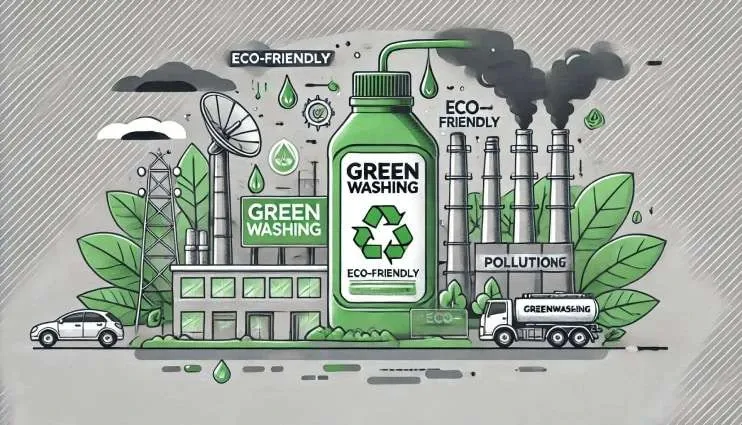
The Industrial Revolution gave birth to many new inventions, technologies and industries. Inventions like polythene, plastic and other non-eco-friendly chemicals and substances came into day-to-day life use among industrialists and consumers. With their rapid usage, environmental pollution started heading towards its peak causing climate change, global warming, loss of biodiversity, certain diseases, ecological imbalance etc.
In the modern days, where people have realized the prejudice of their usage, they are more concerned with the conservation of the environment. Majority of the consumers prefer more sustainable and eco-friendly products and services over traditional ones. Making use of this new consumer approach, some money-minded industrialists falsely promote their products and services as eco-friendly and sustainable to mislead and attract their customers targeting more sales and profits. This is called greenwashing or eco-pornography.
GREENWASHING AND HUMAN RIGHTS
Greenwashing violates consumer protection which is closely linked to the human right to an adequate standard of living recognized in various international human rights instruments, including UDHR (Article 25) and ICESCR (Article 11). Sri Lanka as a state party to UDHR and ICESCR, is obliged to ensure adequate standard of living to its citizens. The right is enshrined under article 27(2)(c) of the Sri Lankan constitution as well.
GREENWASHING IN SRI LANKA
- Cement companies try to greenwash themselves by trying to plant mangroves or plant corals with young people and acting sustainably.
- The tea plantation sector is where entire ecosystems are destroyed, yet companies claim to give a percentage of their profits for conservation when leopards die daily on their estates due to snares and tea-plucker-related encounters.
- Cosmetics which state they are ‘greenest’ and ‘environmentally friendly’ while contained in plastic tubes or bottles.
- Plastic water bottles which mention ‘ecofriendly’ on the polythene label and organic foods contain polythene covers.
- A hospitality company advertised an award that was made by an unknown company based in the UK and awarded by people who have no relevance.
- An apparel company touted itself as sustainable by copying the initiative of another African initiative of dropping mud-encased seedlings across Africa, in Sri Lanka. Burning aero plane fuel to copy the same in a country which has rich soil and lands that are not extensive, is trying too hard to be sustainable to cover up the grim realities of the actual impact on the environment.
MECHANISMS TO ADDRESS GREENWASHING
There is no exclusive law or other mechanism in Sri Lanka that deals with greenwashing. However the Food Act No 26 of 1980 (Section 3), Intellectual Property Act No 36 of 2003 (Section 160(4), Consumer Affairs Authority Act No 9 of 2003 (Section 30, 31) and Sri Lanka Rupavahini Corporation Act No. 6 of 1982 (Section 7) can be utilized to prevent greenwashing to a certain extent.
More effective mechanisms are being followed by state and other entities to address the issue of greenwashing in developed countries.
- ‘The Sins of Greenwashing’: 6 guidelines introduced by Terra Choice, a Canadian private marketing and environmental consultancy. They are sin of the hidden trade-off; sin of no proof; sin of vagueness; sin of irrelevance; sin of lesser of two evils; and sin of fibbing.
- ‘Green Claims Code’: Guidelines introduced by the Competition and Markets Authority of the UK. They are, to be truthful and accurate; be clear and unambiguous; not omit or hide material information; only make fair and meaningful comparisons; consider the full lifecycle of the product or their service; and be substantiated.
- ‘Licence to Greenwash’: It is a report by the Changing Markets Foundation, an NGO based in the Netherlands. The report evaluated the 10 certifications in the fashion and textile industry.
- Six Guidelines: Introduced by the World Federation of Advertisers. They are clear wording; and sufficient information; indicate the limits of durability; advanced comparison; strong evidence for the claim; and demonstrate the impact on the environment.
- Set of guidelines: Introduced by The Federal Trade Commission of USA. Guidelines include, that the language must be clear; the comparative claims should be clear; and there should not be any exaggeration of environmental claims.
- Greenwashing Index: Introduced by the University of Oregon in the UK. It allows the public to give feedback, and rate the various advertisements which make environmental claims.
- Establishment of an exclusive Commission: The Attorneys General Task Force on Environmental Marketing of Minnesota is asked to provide justice for the consumers with the good intention of protecting the environment.
THE BOTTOM LINE
When compared to developed countries, developing countries including Sri Lanka pay very little attention to greenwashing which is an emerging threat which affects the environment as well as innocent consumers. Sri Lanka follows a passive approach towards greenwashing and it is evident that existing laws are not sufficient to address greenwashing efficiently. It is also to be noted that there is a lack of advocacy against greenwashing from non-governmental organizations in Sri Lanka. Therefore, it is recommended that,
- The people should be educated about the practice of greenwashing and its impacts and the ways to distinguish fake and genuine environmental claims.
- Specific laws and policies should be formulated similarly to the UK and Terra Choice to set out the guidelines and standards to mitigate the practice of greenwashing.
- Such laws should also enable the appropriate authorities to receive complaints, conduct investigations and sue against greenwashing companies.
- Mobile applications and forums should be established for the consumers to comment and rate on environmental claims.